


Books of Lights for a New World
To build a better world governed by Love


Natural Birth Within the Intimacy of the Couple
The concept of time in physiological childbirth
Getting in tune with the natural rhythms of birth
The human body has its own intelligence. It is equipped with what is known as the autonomic nervous system, which is capable of performing all vital functions without our consent or control. This is how our heart beats 24 hours a day and we breathe every minute, even when we are asleep, without us being aware of it. Digestion takes place after every meal, the immune system plays its role in protecting us constantly, and repair processes occur when necessary. It is ultimately a kind of magic that we know very little about. In my opinion, the phenomena of childbirth and delivery follow the same processes that allow our mammalian cousins—the giraffes of the savannah, the rabbits of the meadows, the deer of the forest, and all the others—to give birth in nature without medical intervention.
Personally, I deliberately let the physiological processes unfold at their own pace. I was fortunate to have a particularly patient and calm partner by my side, who had absolute confidence in life and was able to remain calm in all circumstances. Recently, while reading some birth stories on social media, I realized that women who choose to give birth in a hospital are faced with professionals who have certain deadlines in mind. Here, I will detail the four crucial moments when I believe it is essential to let the process unfold at its own pace, without panicking unnecessarily, as long as we feel that everything is going well.
1. The birth date
It was in Africa, in Cameroon, that we learned that A CHILD ARRIVES AT ITS OWN TIME. I discuss this in more detail in the article entitled: Physiological childbirth: a baby comes in its own time. A few years later, when we discovered astrology, we became fully aware that it is really the child who chooses the time at which it will come into this world, in harmony with the astral configuration of the moment. Whether you believe in astrology or not is irrelevant. Everyone has the right to their own spiritual beliefs, of course. However, it is essential to realize that calculating a pregnancy day by day, week by week, is something unusual and new. Personally, I calculated my pregnancies by month rather than by week and day. Furthermore, some of them occurred while I was experiencing amenorrhea related to breastfeeding, so I did not have a date for my last period. I am struck by the methods used by the medical world to force and induce labor. Practices such as stripping the membranes or inducing labor with hormones seem completely unnatural to me. Furthermore, walking a lot at the end of pregnancy or having sex with a partner who ejaculates inside the vagina are practices that can certainly cause contractions. However, in my experience, these contractions will only complicate the delivery, but will not trigger it until the baby is ready to be born.
The official duration of a human pregnancy is estimated at around 40 weeks of amenorrhea, and after 41 or 42 weeks, it is considered post-term. It is said that the placenta can no longer provide sufficient nutrients to the fetus, which can lead to complications. In this case, healthcare professionals start to worry and generally recommend artificially inducing labor.
I have not personally experienced going past my due date. However, I have read testimonials from women who, wanting at all costs to give birth peacefully at home, heroically resisted pressure from those around them. In the end, some of them gave birth naturally, sometimes without medical assistance, at 43 weeks, and everything went well, with the joy of welcoming at its own time a baby who was not traumatized and as adorable as can be…
2. The moment of the baby’s birth
Here again, my belief is that the baby chooses the moment of its birth down to the second, and that we do not need to intervene excessively to force its passage. Practices such as the use of tools (forceps, spoons, vacuum extractors) or even asking the woman to push seem completely unnatural to me. My babies came out of my body on their own. I never felt like I had to “push” as is often said. On the contrary, I tried to hold back and support the baby’s head with my hands to avoid tearing my internal organs. This allowed me to preserve my perineum. In addition, I was systematically in an upright position. Gravity is a force that probably helped the baby make this magical passage from one world to another and made this long-awaited miraculous arrival possible for those around the baby.

3. Clamping the umbilical cord
I have read that, officially, early clamping of the umbilical cord is performed 10 to 15 seconds after birth, while delayed clamping is performed one to three minutes after the baby’s arrival, which leaves me speechless. How is this possible? Why such a rush to cut this sacred bond between mother and baby? Officially, it is said that a delay of more than a few minutes can increase the risk of hypothermia and jaundice for the newborn… I am not a midwife… and I admit that I do not understand the logic behind these fears… What is the cause and effect relationship? In any case, none of my eleven babies had this kind of problem…
In absolute terms, there is no need to cut the cord, as there are even people who choose never to cut it and wait for it to fall off on its own. This is called the lotus birth practice, in which the placenta is kept close to the baby, with salt to prevent it from rotting, until the cord detaches naturally at the newborn’s navel a few days later.
Personally, I have not practiced this. However, most of our babies arrived asleep. Christophe usually waited for them to wake up (either several minutes or tens of minutes after delivery) before clamping and cutting the cord. In the video Baby fully respected at birth arrives asleep, you can clearly see that the baby is still attached to me by the cord ten minutes after birth. In the documentary EXPERIENCING BIRTH NATURALLY AND PEACEFULLY, we show in great detail how we proceeded. (See the article Experiencing birth naturally and peacefully on this subject). In general, Christophe took care of clamping and cutting the cord between 20 and 30 minutes after the baby’s arrival, calmly. We always check that the cord is white, meaning it is empty of blood, and that it has completely stopped pulsating. We check that the baby is breathing properly through its lungs, meaning that it has become autonomous in terms of breathing and no longer needs me, via the placenta, to supply oxygen to its body. This seems fundamental to me, and I find that one minute for this is really very limited.
Out of love for the baby, I think it is essential to realize that this fetus, which has been breathing for months in the womb through the placenta, may need a few minutes or even tens of minutes before it can breathe completely through its lungs. This phenomenon is completely new to it. So why the rush? What’s the point? Where is the love and respect for the newborn who has just arrived in this world?
4. Delivery of the placenta
My first baby was born in the car at 6:30 a.m. We arrived at the clinic at 6:40 a.m., and there was general panic. The staff came to the car to cut the cord and carried me on a stretcher to the delivery room. There, between four and six arms brutally pounded on my uterus to get the placenta out. I tried to tell the staff that since the baby had come out quickly and easily, without pain, the placenta would eventually come out on its own. But I realized that I had no say in the matter, because I was not at home. They told me that they absolutely wanted to get the placenta out before 7:00 a.m., when the night shift handed over to the day shift. I talk more about this experience in the following video: The path to natural birth experienced as a couple.
I recently read, based on official data I found, that if the placenta has not come out within 30 minutes after delivery, it is referred to as placental retention. This is considered a risky situation, as the woman is at risk of hemorrhaging because placental retention prevents the uterus from contracting completely… How? These statements remain a mystery to me… Where is the real risk? I am not a doctor, gynecologist, or midwife… I am a life sciences engineer and I admit that I do not understand the logic…
My logic, as I understand it, is that the placenta is attached to the uterus throughout the pregnancy, allowing the essential exchange of blood between the mother and the baby. After birth, the placenta, which is no longer needed, must detach from the uterus in the same way that a leaf detaches from a tree in the fall and falls to the ground. This detachment process in my body took about two hours on average. So, for most of my deliveries, I waited two hours before expelling the placenta. This meant I didn’t experience any bleeding. I’m surprised that even today, even in hospitals, so many women still suffer from postpartum hemorrhage. Is it certain that delivery within 5 to 30 minutes after birth avoids any risk of hemorrhage? (See the article Reducing the risk of hemorrhage during childbirth on this subject)
I have witnessed two examples, either directly or indirectly, of women whose delivery of the placenta took place almost 24 hours after the birth of their baby. By allowing the process to take its course, there were no negative consequences, no hemorrhage, and no infection.
The first example is that of my Quechua neighbor. I have been living in the Andes in Bolivia since 2009. One day in August 2023, one of my Quechua neighbors, a farmer, called me to ask for help. She explained that her sister had given birth to her fifth child at home without medical assistance (there is no bathroom in her adobe house; they are modest people, with no tiles or wall coverings either). The baby had been born 24 hours earlier and the placenta had still not come out… So I went to her house… When I arrived, I found the baby dressed and peaceful on a bed. My neighbor was calm and not bleeding. I checked that her placenta had detached, which it had, unsurprisingly… So I helped her to allow the placenta to come out… 30 minutes after my arrival, the placenta had come out… My neighbor didn’t bleed at all and didn’t have an infection…
The second example is that of a woman I got in touch with through Facebook groups. This woman gave birth to her first baby at home in the heart of conjugal intimacy in France in September 2024. The baby was born at 10 a.m., but the placenta did not come out quickly. In the afternoon, around 5 p.m., she called the emergency services to find out what would be done in her situation. She was told that she would need general anesthesia to remove the placenta from her body. She was not at all happy with this scenario, especially as she was feeling fine and had no bleeding. So she decided to stay quietly at home. Finally, the placenta came out of her body during the night, about 14 hours after the birth. She had no bleeding or infection. Looking back on this experience, she says she is happy that she trusted her body and the women she had contacted on social media, who had encouraged her to follow her instincts without letting herself be overwhelmed by unnecessary fears.
These two examples prove that, frankly, as long as the woman feels well and is not bleeding, it is better to be patient rather than worry excessively.
In conclusion
Personally, I have great faith in life and the miracles that are at work in each of our bodies. I believe that natural and physiological processes are magical and that, in most cases, if we let them unfold as they should, everything will turn out fine. Of course, there may be cases where there are emergencies, malformations, complications, dangers, risks… It is up to each woman to listen to her body and heart in order to make the best decisions at any given moment. The medical world can, of course, be of great help in certain complicated situations. But as long as we feel good and, at the level of our soul, we have the intuition that everything is aligned, what is the point of forcing, worrying, panicking, intervening, wanting to anticipate or accelerate the processes?
It seems to me that, in most cases, these interventions unfortunately only complicate a situation that could have unfolded harmoniously if it had been given time to do so…
Haste and stress are based on fear, not love… and fear is the source of every possible and imaginable disaster… Love is the antidote to fear. Love is the source of deep peace, genuine respect, a precious sense of tranquility, and a feeling of authentic harmony and satisfaction.
If you choose to listen to your heart rather than the anxieties of others, you will know what is right and aligned for you and your baby at every moment. Your mother’s heart is better than anyone else at guiding you on the path of love…
Therein lies the key to experiencing a birth in harmony with natural rhythms, a birth that you will always remember fondly…

“To offer my baby a birth with all the Respect and Love they deserve…
and thus create within their subconscious
a positive imprint of self-confidence and trust in life
that will remain deeply rooted within them forever…”
This article was written by Claire Loiseleur, mother of eleven children all born within the heart of marital intimacy, through our conscious choice to offer our babies a birth with all the Love and Respect they deserve, and co-author of the book and documentary:

NATURAL BIRTH WITHIN THE INTIMACY OF THE COUPLE
Our Journey of Welcoming Eleven Children in Peace, Respect and Love
This book is being translated. Thank you for your patience.
Filled with music and colours, and enriched with numerous captions and voice-over explanations, the documentary EXPERIENCING BIRTH NATURALLY AND PEACEFULLY beautifully complements the teachings shared in the book NATURAL BIRTH WITHIN THE INTIMACY OF THE COUPLE.
This film is available as a streaming video, with instant viewing through a private personal link offering unlimited access.
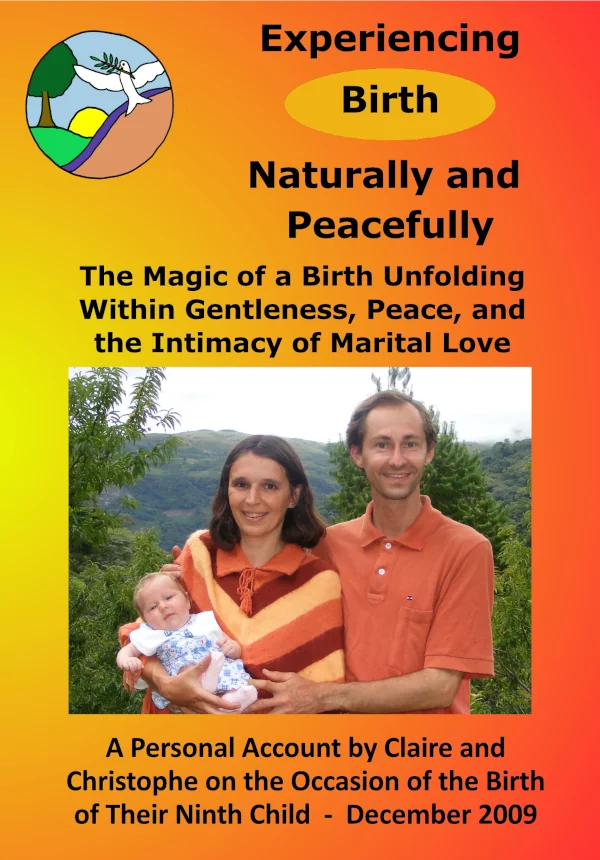
EXPERIENCING BIRTH NATURALLY AND PEACEFULLY
The Magic of a Birth Unfolding Within Gentleness, Peace and the Intimacy of Conjugal Love
A Personal Account by Claire and Christophe on the Occasion of the Birth of Their Ninth Child – December 2009
Read more articles on the topic of respectful childbirth.
A list of these 22 articles, along with a brief summary of each, is available on the following page:


The book GIVING BIRTH NATURALLY AND FREELY AS A COUPLE is part of the Lights for a New World books presented on the Youtube channel and Facebook page entitled : Lights for a New World




The expression « Lights for a New World » is explained on the following page :
“What I call the New World is an ideal world — the world we dream of living in: a better world, fairer, more beautiful, more harmonious, more pleasant to live in, and ultimately happier. A world freed from fear and the games of the ego. A world governed by the forces of authentic, unconditional, and universal love. A world where peace, joy, tolerance, and kindness have become the norm.
Gandhi said: ‘Be the change you wish to see in the world,’ and it is up to all of us to act, each at our own level, to begin building this New World today. Let us stop criticizing everything we dislike on this Earth: it is wasted time and energy!
Let us put on our glasses of love and, together, become the courageous builders of a better world — one increasingly aligned with the ideal we feel deep within our heart — knowing that, as Albert Schweitzer said: ‘The ideal remains for us what a star is for the sailor. It cannot be reached, but it remains a guide.'”