


¡Viva la Vida! center
To regenerate your health by living in harmony with Nature


Natural approaches to cancer by scientists
Louis-Claude Vincent’s bioelectronics
The visionary scientist who showed that cancer can only develop and thrive in an acidic, oxidized environment saturated with minerals
Louis-Claude Vincent, a hydrologist by training, devoted his life to understanding how water quality influences human health. By observing the correlations between the physicochemical characteristics of water in French municipalities and the health status of their inhabitants, he developed a rigorous scientific method: bioelectronics. This method allows objective measurement of biological terrain through three fundamental parameters: pH (acidity or alkalinity), rH2 (oxidation-reduction potential), and resistivity (mineral concentration). His work revealed that cancer appears in terrain presenting a very particular bioelectronic signature: slightly alkaline blood compensating for tissue acidification, associated with intense oxidative stress and mineral overload. These dysfunctions create an environment where cells can no longer breathe properly and switch to fermentation. By precisely identifying these imbalances, Vincent paved the way for a preventive and curative approach based on restoring terrain balance, thus joining Otto Warburg’s discoveries on cancer metabolism.
1. An engineer who became a researcher in the service of health
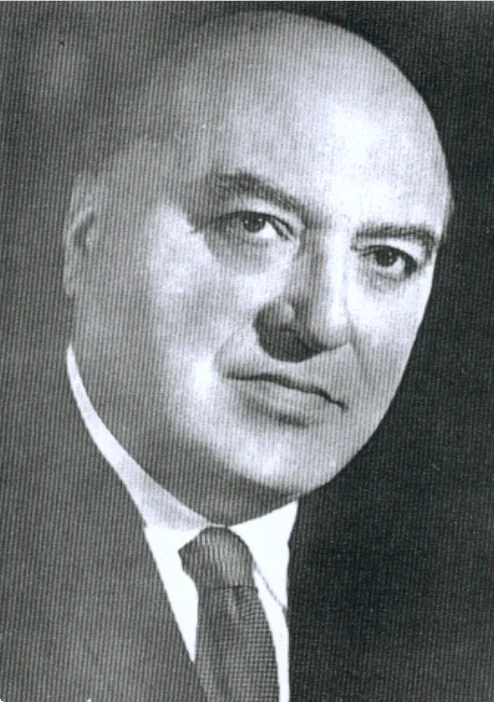
Born in 1906 in southern France, Louis-Claude Vincent pursued engineering studies and specialized in hydrology. From 1926, he worked for hundreds of French municipalities on drinking water supply and sanitation projects. His work led him to analyze daily the quality of water intended for human consumption, and it was there that his eye sharpened.
Throughout his missions, Vincent noticed a troubling correlation: in certain regions where water presented particular physicochemical characteristics, inhabitants seemed more affected by certain diseases, particularly cancer. Intrigued by these observations, he decided to investigate further and began systematically studying the link between water quality and population health.
This approach led him to develop a totally new scientific approach. Rather than relying on conventional chemical analyses that are limited to identifying substances present in water, Vincent sought to understand the energetic and electromagnetic properties of liquids. He sensed that these invisible characteristics play a determining role in water’s capacity to support or, conversely, to weaken life.
In 1948, after years of research and meticulous measurements, he officially founded bioelectronics, a discipline aimed at objectively evaluating the biological terrain of living beings. This method is not limited to water: it also applies to physiological fluids such as blood, saliva, and urine. Vincent thus moved from hydrologist engineer to true biology researcher, opening an original path that connects chemistry, physics, and preventive medicine.
In 1954, he became a professor and taught his method at the École d’anthropologie de Paris. He collaborated with Dr. Jeanne Rousseau, a physician passionate about natural approaches, and together they refined bioelectronics by applying it to thousands of patients. Their work allowed precise mapping of biological terrain and better understanding of conditions that favor health or, conversely, disease.
Despite the scientific rigor of his research, Vincent quickly encountered incomprehension and even hostility from the medical and industrial world of his time. His conclusions were disturbing: they questioned the quality of water distributed in public networks and suggested that certain medical practices could durably unbalance biological terrain. Refusing to renounce his convictions, he nevertheless pursued his work relentlessly until his death in 1988, leaving behind a considerable but largely unknown scientific legacy.
2. Analyses to understand biological terrain
Louis-Claude Vincent’s bioelectronics is based on a simple but revolutionary principle: measuring three fundamental physicochemical parameters to assess the quality of biological terrain. These three measurements go beyond conventional chemical analysis, which merely identifies the substances present. Louis-Claude Vincent sought to understand the energetic and electromagnetic properties of liquids, invisible characteristics that play a decisive role in an environment’s ability to sustain or weaken life.
The three bioelectric parameters
The first parameter is pH, which measures a liquid’s acidity or alkalinity on a scale from 0 to 14. A pH below 7 indicates an acidic medium, while a pH above 7 signals an alkaline (or basic) medium. This measurement informs us about acid-base balance, a fundamental equilibrium for all biochemical processes of life. Enzymes, proteins, and cellular reactions function in very precise pH ranges. An acid-base imbalance profoundly disturbs metabolism and creates conditions favorable to disease.
The second parameter is rH2, or redox potential. This parameter measures a medium’s capacity to capture or release electrons, thus reflecting its degree of oxidation or reduction on a scale from 0 to 42. A high rH2 (above 28) indicates an oxidized medium, characterized by the presence of free radicals and oxidative stress. A low rH2 (below 28) reveals a reduced medium, rich in available electrons and natural antioxidants. The rH2 is a precious indicator of energetic vitality: it tells us whether an organism has enough electrons to maintain its vital functions and protect itself from premature aging, or whether it tips toward a state of excessive oxidation that accelerates cellular degeneration.
The third parameter is resistivity, noted ρ (rho), expressed in ohms per centimeter (Ω.cm). It measures a liquid’s capacity to conduct electricity, which depends directly on its concentration of dissolved minerals and electrolytes. The more minerals a liquid contains, the more easily it conducts electric current, and the lower its resistivity. Conversely, pure, low-mineral water presents high resistivity. For Louis-Claude Vincent, high resistivity in physiological fluids is beneficial to health, as it indicates that the organism correctly eliminates its mineral waste and is not clogged. Too-low resistivity reveals an overload of inorganic salts, heavy metals, and toxic residues that slow cellular exchanges and obstruct tissues.
Perfect water according to Louis-Claude Vincent
Louis-Claude Vincent devoted a large part of his research to defining what he called “perfect water,” that is, water whose bioelectric characteristics optimally support life and health. According to his measurements, ideal water presents the following characteristics:
- Slightly acidic pH: between 6.0 and 6.8, close to that of natural spring water
- Low rH2: between 25 and 28, indicating moderate reducing power that protects against oxidation
- High resistivity: above 6,000 Ω.cm, revealing very low mineral load
This perfect water is found naturally in certain pure spring waters, in unpolluted rainwater, and can be obtained by reverse osmosis followed by slight energization. Conversely, tap water, generally alkaline (pH > 7), oxidized (rH2 > 30), and loaded with inorganic minerals (low resistivity), falls short of Louis-Claude Vincent’s criteria. This water, although it meets sanitary potability standards, does not optimally support cellular vitality and may even contribute, in the long term, to organism clogging.
Food from a bioelectronic perspective
Louis-Claude Vincent also applied his method to food analysis, revealing that what we eat directly influences the three bioelectric parameters of our terrain.
From a pH perspective, foods fall into two categories. Acidifying foods are mainly animal products (meats, fish, eggs, dairy products), refined cereals, overcooked or industrially processed foods, and products devitalized by preservation processes. These foods leave acid residues in the organism that overload the body’s buffer systems and progressively acidify tissues. Conversely, alkalizing foods are essentially fresh plants: green vegetables, ripe fruits, sprouted seeds, algae. These foods provide easily assimilable organic minerals that support acid-base balance and help neutralize metabolic acidity.
From an rH2 perspective, foods are distinguished by their antioxidant content or oxidizing tendency. Free radicals are unstable molecules that tear electrons from healthy cells, causing oxidative stress and cellular damage. Processed, fried, overcooked foods or those preserved with chemical additives generate free radicals and increase the organism’s rH2. Conversely, antioxidants are molecules capable of giving electrons without themselves becoming unstable, thus protecting cells from oxidative stress. They are found in abundance in fresh, raw fruits and vegetables, oil seeds, aromatic herbs, and fresh juices. These living foods maintain low rH2 and preserve cellular vitality.
From a resistivity perspective, foods differ by their toxic load. A healthy food, grown in organic agriculture on living soil and harvested at maturity, mainly contains structured water and bioavailable nutrients. Its resistivity is high, reflecting its purity. Conversely, a devitalized food, grown with pesticides and chemical fertilizers, harvested before maturity, industrially processed and enriched with additives, accumulates toxic residues: pesticides, heavy metals, preservatives, colorants. These substances overload the organism with non-assimilable elements that lower the resistivity of body fluids and clog tissues. This same logic applies to synthetic chemical medicines, which introduce highly mineralized foreign molecules into the body, durably disrupting bioelectric balances.
By combining these three parameters, Louis-Claude Vincent created a true coordinate system allowing evaluation of the bioelectric quality of water, foods, and, as we will see, the health status of a living organism
3. Bioelectronics: revealer of terrain, mirror of health status
For Louis-Claude Vincent, illness never appears by chance. It is always the consequence of biological terrain imbalance. This idea echoes Claude Bernard’s famous statement: “The microbe is nothing, the terrain is everything.” What Vincent brought that was new is the possibility of objectively measuring this terrain through his three bioelectric parameters.
According to Vincent, a healthy organism has slightly alkaline terrain (blood pH between 7.35 and 7.45), is slightly reducing (rH2 between 21 and 23), and has low mineralization (high resistivity, 175-210 Ω.cm). Under these conditions, cells breathe harmoniously, metabolic exchanges occur correctly, and the immune system functions optimally. The organism then has all necessary resources to maintain its homeostasis and defend itself against external aggressions.
But when this terrain becomes imbalanced — due to toxin accumulation, chronic stress, poor diet, increasing pollution — everything shifts. Toxins accumulate and acidify cellular tissues (even if blood attempts to compensate by becoming slightly more alkaline). Simultaneously, these toxins create oxidative stress that increases rH2 well beyond 23, while mineral overload causes resistivity to collapse. A terrain that progressively slips out of health zones becomes “acido-oxidized” terrain — characterized by slightly alkaline blood pH to compensate for acidic tissue pH, with high rH2 and low resistivity — which places the individual in a zone of increased vulnerability.
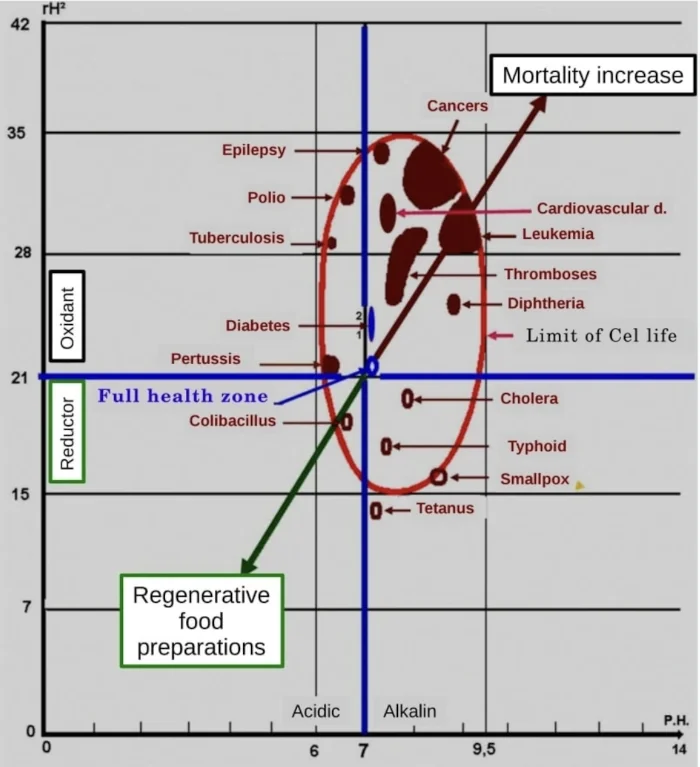
Vincent observed, after thousands of measurements performed on sick people, that each type of pathology corresponds to a specific zone of the bioelectronic diagram. This mapping allows understanding that the same individual will not develop just any disease: everything depends on the state of their biological terrain at the moment when stress factors become too important.
The major interest of bioelectronics is that it allows intervention upstream, before disease sets in. By regularly measuring the three bioelectric parameters, it becomes possible to detect deviations in the terrain and correct them by natural means: dietary modification, improvement of drinking water quality, stress management, reinforcement of toxin elimination. This preventive approach, based on restoring the balance of the terrain, is fully in line with the philosophy of natural health.
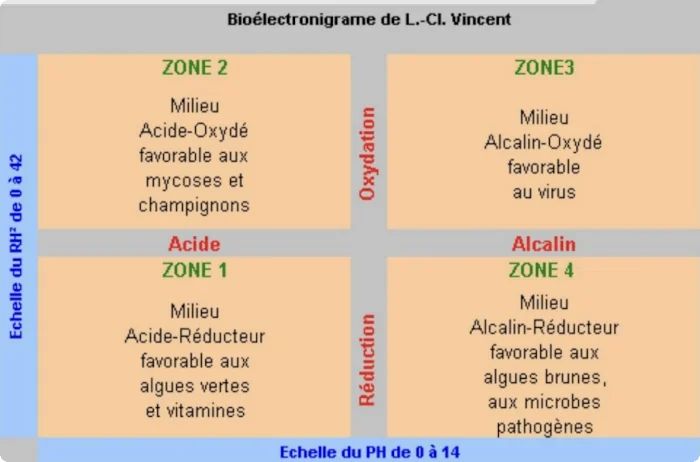
Vincent also highlighted an essential point: conventional medical interventions systematically displace terrain toward unfavorable zones. Rather than restoring balance, they further acidify the internal environment, overload the organism with undesirable minerals, and disturb redox processes by notably increasing oxidative stress. This observation joins the idea that true healing can only come from restoration of natural physiological balances.
4. Cancer seen as a crisis of tissue acidosis and oxidative stress in the body
To understand cancer according to Louis-Claude Vincent, one must grasp the central paradox of this pathology: cancer appears in an environment where blood becomes alkaline by compensation, while cellular tissues become deeply acidified, oxidative stress intensifies, and toxic load accumulates.
Here is the exact dynamic: when toxin accumulation exceeds what the organism can manage, these toxins accumulate in tissues, acidify them, and create major oxidative stress. Cancer cells thrive precisely in this environment: tissue acidity, intense oxidative stress, high toxic load. To compensate for this imbalance that would immediately threaten life, the organism reacts by mobilizing its buffer system: the kidneys produce bicarbonates that neutralize accumulated tissue acidity, which raises blood pH toward 7.4-7.8, even though tissues remain deeply acidic. Blood thus attempts to protect itself by becoming more alkaline, even though this compensation signals a worrying biological imbalance.
This dissociation between blood (which is easily measured) and cellular terrain (which is the true metabolic reality) is fundamental to understanding bioelectric measurements in a cancer patient. This is exactly what Otto Warburg had discovered when studying cancer cell metabolism: in this acidic, oxidative, and toxic environment, cells can no longer breathe correctly. They then switch to glucose fermentation to survive, producing lactic acid in abundance, which worsens local acidosis. Louis-Claude Vincent, by objectively measuring bioelectric terrain, confirmed and completed this discovery.
Tissue acidosis revealed by pH measurements
The pH of the three biological fluids strikingly reveals this paradox. In a person in excellent health, blood pH may be slightly lower (7.07-7.1) than average when this person practices calorie restriction or intermittent fasting, states that favor beneficial physiological acido-ketosis. This slightly acidic pH testifies to optimal metabolism where cells efficiently use ketone bodies and maintain high-performance mitochondrial respiration. This is the terrain observed in high-level athletes and people living in optimal natural conditions.
In an average healthy person, blood pH is between 7.35 and 7.45, so it is slightly alkaline. This range represents the standard balance of the general population, where the organism maintains its homeostasis without excessive compensation.
In contrast, in a cancer patient, blood pH rises beyond 7.45, often reaching 7.6 or even 7.8. This blood alkalosis is a sign of compensation by a buffer mechanism facing deep tissue acidosis. Simultaneously, urine becomes very acidic (pH < 5.8), revealing the kidneys’ desperate attempt to eliminate excess acidity. Saliva also acidifies (pH < 6.5), reflecting general acidification of extracellular fluids and global metabolic imbalance.
The following table synthesizes these observations:
Table 1: Comparison of pH values according to Vincent’s bioelectronics
|
Biological fluid |
pH of a |
Interpretation of full health |
Normal pH |
Interpretation of normal condition |
Typical pH of a cancer patient |
Interpretation of cancerous state |
|---|---|---|---|---|---|---|
|
Blood |
7,07 to 7,1 |
Slightly more acidic pH linked to healthy acidosis, optimal metabolism |
7,35 – 7,45 |
Slightly acidic environment, optimal waste elimination |
7,4 – 7,8 |
Blood alkalosis: compensation by buffer mechanism in response to tissue acidosis |
|
Urine |
6,0 to 6,5 |
Good elimination, controlled acidic environment, adapted metabolism |
5,8 – 6,8 |
Slightly acidic environment, optimal waste elimination |
< 5,8 |
Urinary acidosis, insufficient elimination of accumulated acidic toxins |
|
Saliva |
|
Healthy oral environment, good metabolic balance |
6,5 – 7,0 |
Slightly acidic environment, good metabolic balance |
< 6,5 |
Acidification of extracellular fluids, unbalanced environment |
Oxidative stress revealed by rH2 measurements
Le potentiel d’oxydo-réduction (rH2) des trois liquides biologiques révèle une autre facette essentielle du terrain cancéreux : le stress oxydatif massif qui accompagne la maladie.
Chez une personne en excellente santé, le rH2 sanguin se situe entre 20 et 21, reflétant un terrain réducteur sain où les cellules disposent d’électrons en abondance pour se protéger du stress oxydatif. L’urine (rH2 21-22) et la salive (rH2 21,5-23) présentent également des valeurs basses, témoignant d’un métabolisme énergétique optimal.
Chez une personne en bonne santé moyenne, le rH2 sanguin se situe entre 21 et 23, la urine entre 23 et 25, et la salive entre 21 et 25,5. Ces valeurs légèrement plus élevées indiquent un équilibre métabolique correct, même si l’organisme fait face à davantage de stress oxydatif que dans un état d’excellence.
Mais chez un malade cancéreux, le rH2 sanguin s’élève à 28 ou au-delà, révélant un sang fortement oxydé. Ce n’est pas que les cellules cancéreuses produisent directement cette oxydation sanguine — c’est encore une fois une compensation. Au niveau tissulaire, le milieu tumoral est réducteur, pauvre en oxygène, favorisant la fermentation anaérobie. Mais le sang réagit en devenant oxydant pour tenter de compenser ce déficit d’oxygénation locale. Cette oxydation sanguine traduit un stress oxydatif systémique majeur : les membranes cellulaires sont endommagées, les mitochondries sont perturbées, et la dégénérescence s’accélère. L’urine (rH2 > 26) et la salive (rH2 > 26) montrent également une oxydation excessive, reflétant l’épuisement des systèmes antioxydants de l’organisme.
Le tableau suivant synthétise ces observations :
Comparaison des valeurs de rH2 (potentiel redox) selon Vincent
|
Liquide biologique |
|
Interprétation de l’état de pleine santé |
rH2 normal |
Interprétation de l’état normal |
rH2 typique |
Interprétation de l’état cancéreux |
|---|---|---|---|---|---|---|
|
Sang |
20 à 21 |
Terrain réducteur sain, équilibre optimal des échanges |
21 – 23 |
Terrain réducteur équilibré, bon potentiel oxydatif |
≥ 28 (élevé, oxydation forte) |
Stress oxydatif majeur, hypoxie, dégénérescence cellulaire |
|
Urine |
21 à 22 |
Bon renouvellement, milieu métabolique sain |
23 – 25 |
Bonne élimination, milieu stable réducteur |
> 26 |
Élimination perturbée, terrain oxydé |
|
Salive |
21,5 à 23 |
Variable, souvent plus élevée |
21 – 23
|
Équilibre métabolique stable |
> 26 |
Dégénérescence du terrain biologique |
La surcharge toxique révélée par les mesures de résistivité
La résistivité des trois liquides biologiques révèle la troisième dimension du terrain cancéreux : l’encrassement toxique et minéral de l’organisme.
Chez une personne en excellente santé, la résistivité sanguine se situe entre 190 et 210 Ω.cm, indiquant un sang fluide, riche en électrolytes organiques bien assimilés, avec une microcirculation optimale. L’urine (40-65 Ω.cm) et la salive (190-210 Ω.cm) présentent également des valeurs cohérentes avec une élimination efficace et un milieu buccal équilibré.
Chez une personne en bonne santé moyenne, la résistivité sanguine se situe entre 175 et 210 Ω.cm, l’urine entre 29 et 70 Ω.cm, et la salive entre 180 et 220 Ω.cm. Ces valeurs reflètent un équilibre électrolytique normal et une capacité d’élimination correcte.
Par contre, chez un malade cancéreux, la résistivité sanguine s’effondre à 100-140 Ω.cm, révélant un encrassement minéral actif, en conséquence d’une surcharge minérale et toxique. Cette résistivité basse indique que le sang est encombré par l’accumulation de sels inorganiques, de métaux lourds, de déchets métaboliques et de résidus médicamenteux que les émonctoires ne parviennent plus à éliminer. Cette surcharge ralentit les échanges cellulaires, obstrue la microcirculation dans les capillaires, perturbe la communication entre les cellules et crée un terrain propice à la dégénérescence. L’urine (résistivité ρ < 29 Ω.cm) confirme cette surcharge toxique avec une filtration rénale insuffisante.
Paradoxalement, la salive présente une résistivité élevée (ρ > 220 Ω.cm). Ce n’est pas un signe de pureté, mais d’un encrassement chronique différent : une déminéralisation relative des sécrétions actives couplée à une déshydratation salivaire et des dépôts collants (mucus, protéines dénaturées) qui agissent comme des « isolants » au sens électrique du terme. Cette salive à la fois sèche et visqueuse traduit un terrain systémique épuisé, incapable de maintenir une sécrétion salivaire équilibrée, et reflète la compensation oxydante globale du corps face à l’acidose tumorale. Ces trois valeurs — résistivité basse pour le sang et l’urine, élevée pour la salive — confirment le déséquilibre métabolique systémique et l’encrassement chronique de l’organisme caractéristiques d’un malade atteint par le cancer.
Le tableau suivant synthétise ces observations :
Comparaison des valeurs de résistivité selon Vincent
|
Liquide biologique |
Résistivité d’une |
Interprétation de l’état de pleine santé |
Résistivité normale |
Interprétation de l’état normal |
Résistivité typique d’un malade cancéreux |
Interprétation de l’état cancéreux |
|---|---|---|---|---|---|---|
|
Sang |
|
Sang fluide et riche en électrolytes, microcirculation optimale |
175 – 210 Ω.cm |
Sang fluide, bonne microcirculation et équilibre électrolytique |
100 à 140 Ω.cm |
Sang plus fluide, encrassement, dysfonction électrique et oxydatif Surcharge toxique, encrassement, dégénérescence |
|
Urine |
40 à 65 Ω.cm |
Bonne fonction rénale, élimination efficace |
29 – 70 Ω.cm |
Fonction d’élimination optimale |
< 29 Ω.cm |
Élimination insuffisante des déchets |
|
Salive |
|
Fluide buccal équilibré, bonne hydratation |
180 – 220 Ω.cm |
Bon état buccal, hydratation équilibrée |
> 220 Ω.cm |
Acidification et toxémie du terrain |
La signature bioélectronique du cancer
Ces trois tableaux révèlent une signature bioélectronique caractéristique du cancer : un sang légèrement alcalin mais fortement oxydé, associé à une surcharge minérale et toxique. C’est cette combinaison — pH alcalin + rH2 élevé + résistivité basse — qui place le cancer dans la zone « alcaline oxydée » du diagramme de Louis-Claude Vincent, en haut à droite. Cette zone reflète un déséquilibre métabolique profond malgré la compensation apparente du pH sanguin.
Cette signature bioélectrique confirme que le cancer n’est pas une anomalie génétique mystérieuse, mais la conséquence logique d’un milieu intérieur profondément déséquilibré — alcalin en apparence au niveau sanguin (par compensation tampon), mais acide en réalité au niveau tissulaire, fortement oxydé et lourdement intoxiqué. Plus le cancer est avancé, plus les mesures bioélectriques s’éloignent des valeurs de santé, confirmant que le cancer est le point culminant d’une dégradation progressive du terrain biologique.
5. The need to restore acid-base balance to cure cancer
Louis-Claude Vincent’s approach is not to destroy cancer cells with aggressive treatments, but to restore the balance of the biological terrain so that cancer can no longer develop. This view is in line with that of Otto Warburg and many other researchers who understood that cancer is primarily a disease of the terrain.
To restore this balance, the first priority is to correct acidosis. This requires a radical change in diet: eliminating acidifying foods (refined sugars, processed grains, excess animal proteins, dairy products, chemical additives) and favoring alkalizing foods (green vegetables, ripe fruits, sprouted seeds, fresh juices). The goal is to reduce the load of hydrogen ions (H+ protons) that acidify tissues and provide the body with the organic minerals and electrons it needs to restore its optimal pH.
The second step is to reoxygenate the body by increasing rH2. This involves practicing deep, conscious breathing, regularly exposing yourself to fresh air and sunlight, and engaging in moderate physical activity that stimulates blood circulation and tissue oxygenation. Fasting or calorie restriction also plays a key role: by temporarily depriving the body of glucose, cells are forced to reactivate their mitochondrial respiration and abandon fermentation. This reactivation of cellular respiration is the key to reversing the Warburg effect and allowing cells to return to normal metabolism.
The third essential action is to reduce the mineral load by improving resistivity. Louis-Claude Vincent emphasized the importance of drinking water with very low mineralization, similar to rainwater or pure spring water. This water, which is slightly acidic and not very conductive, helps drain excess minerals and cleanse tissues deeply. It facilitates the elimination of toxins by the kidneys and helps restore the fluidity of physiological fluids. At the same time, it is essential to support the emunctory organs (liver, kidneys, intestines, skin, lungs) to accelerate the elimination of accumulated waste.
Louis-Claude Vincent also warned against conventional medical treatments that aggravate the imbalance of the terrain. Chemotherapy, for example, introduces powerful toxins that further acidify the body, overload the liver and kidneys, and permanently disrupt bioelectrical balances. Rather than restoring health, these treatments push the terrain into an even more unfavorable state, which explains why recurrences are so frequent.
On the other hand, when the terrain is properly rebalanced—pH harmonized, oxygenation restored, mineral load lightened—cancer cells find themselves in an environment that is no longer suitable for them. Deprived of their acidic and anaerobic environment, they can no longer ferment effectively and lose their proliferative advantage. At the same time, the immune system, freed from oxidative stress and toxic buildup, regains its ability to recognize and eliminate abnormal cells. The body can then initiate its natural self-healing process.
This approach requires time, patience, and total commitment. It involves radically changing one’s lifestyle, moving away from carcinogenic factors (pollution, stress, junk food, sedentary lifestyle) and adopting cancer-fighting habits (raw food, pure water, conscious breathing, exercise, contact with nature, inner peace). But it offers a respectful, non-violent, and sustainable path to healing that allows the body to regain its deep balance and original vitality.
- Conclusion: Valuable insights into cancer and the paths to regeneration
The measures developed by Louis-Claude Vincent more than seventy years ago remind us that true health is simply rooted in respect for the natural laws of life. Through his scientific rigor and genius for observation, this engineer made a major contribution to the understanding of cancer. By developing bioelectronics, he gave natural health practitioners an objective and reproducible tool for measuring the biological terrain and identifying the imbalances that promote disease. His work confirms and complements that of Otto Warburg: cancer is not a mysterious genetic anomaly, but a reflection of a deeply unbalanced internal environment—too acidic, too reductive, and too mineralized as a result of excessive toxin overload.
This view of cancer as a disease of the terrain opens up a radically different path to healing than the conventional approach. Rather than seeking to destroy cancer cells with aggressive treatments that aggravate the imbalance, the aim is to restore the physiological conditions that allow cells to breathe properly and the immune system to function harmoniously. By correcting acidosis, reoxygenating the body, and reducing the toxic load, the body naturally regains its balance and self-healing capacity.
It is in this spirit that the ¡Viva la Vida! center supports children with cancer in the natural regeneration of their health. By offering them an environment that I describe as “carcinofugal”. Carcinofugal is a word I created, because surprisingly, the word carcinogenic has no opposite in the dictionary. According to my definition, “carcinofugal” means conducive to the disappearance of cancer, the exact opposite of carcinogenic. Thus, the environment at the ¡Viva la Vida! center is carcinofugal with clean mountain air, low-mineralized rainwater, a living and alkalizing diet, regular exposure to sunlight, moderate physical activity, and the absence of stress. All these conditions combined create a bioelectric environment conducive to the natural regeneration of the health of children with cancer, with all the respect and love they deserve.

“Our body is a divine, marvelous, and magical creation that was originally designed to function perfectly and enable us to live in excellent health throughout our lives.
If cancer does occur, let us have the humility to recognize that our body may have been subjected to a level of stress beyond what it was capable of handling.
By identifying with honesty and clarity the causes of this terrible disease, it becomes possible to act directly at the root of the problem with awareness, intelligence, and love. It is in this spirit that we can choose to follow the path of natural healing, the path of moving forward in harmony with the laws of life to return to the state of full health that is the birthright of each and every one of us.”
This article was written by Claire Loiseleur, founder and host of the ¡Viva la Vida! Center, whose mission is to help the residents who come to stay there regenerate their health through a lifestyle in harmony with Nature.
To understand what the Centre ¡Viva la Vida! is and how it works, I cordially invite you to:

To see this regeneration in action through videos and real testimonials, I invite you to:
Beyond that, to go further and understand the foundations of the natural health approach practiced at the Center — its principles, its thinkers, and its approach to cancer — I wholeheartedly invite you to:

Here is a list of compelling and evidence-based articles about NATURAL APPROACHES TO CANCER BY SCIENTISTS :

Go to the YouTube channel ¡VIVA LA VIDA! Center – english:


See the Facebook page: The Viva la Vida Center

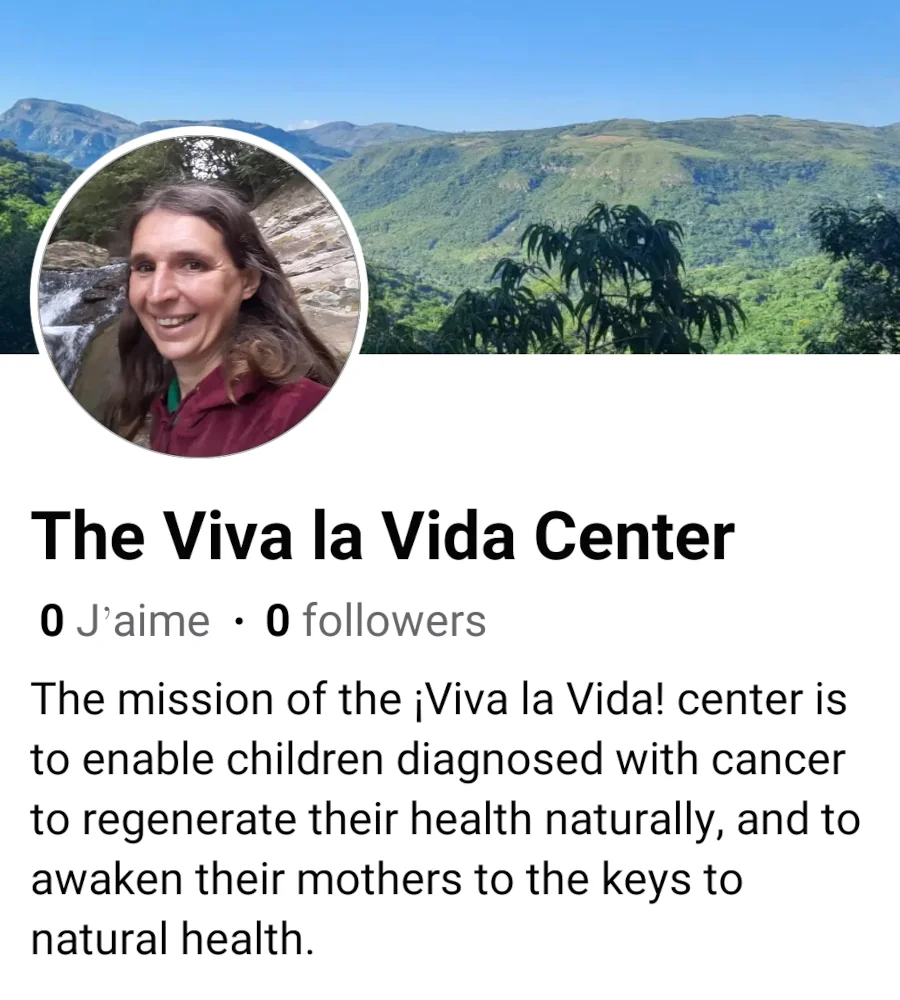
The Facebook group REGENERATING HEALTH BY LIVING IN HARMONY WITH NATURE is a warm and friendly forum for exchange on the theme of Healing pediatric cancer using natural methods. It is open to all parents who have a child with cancer and who are curious to discover the extent to which the keys to natural health can help regenerate their child’s health. The aim is to help each other move forward, beyond the obstacles we face, in order to offer children with cancer natural healing with all the respect and love they deserve.
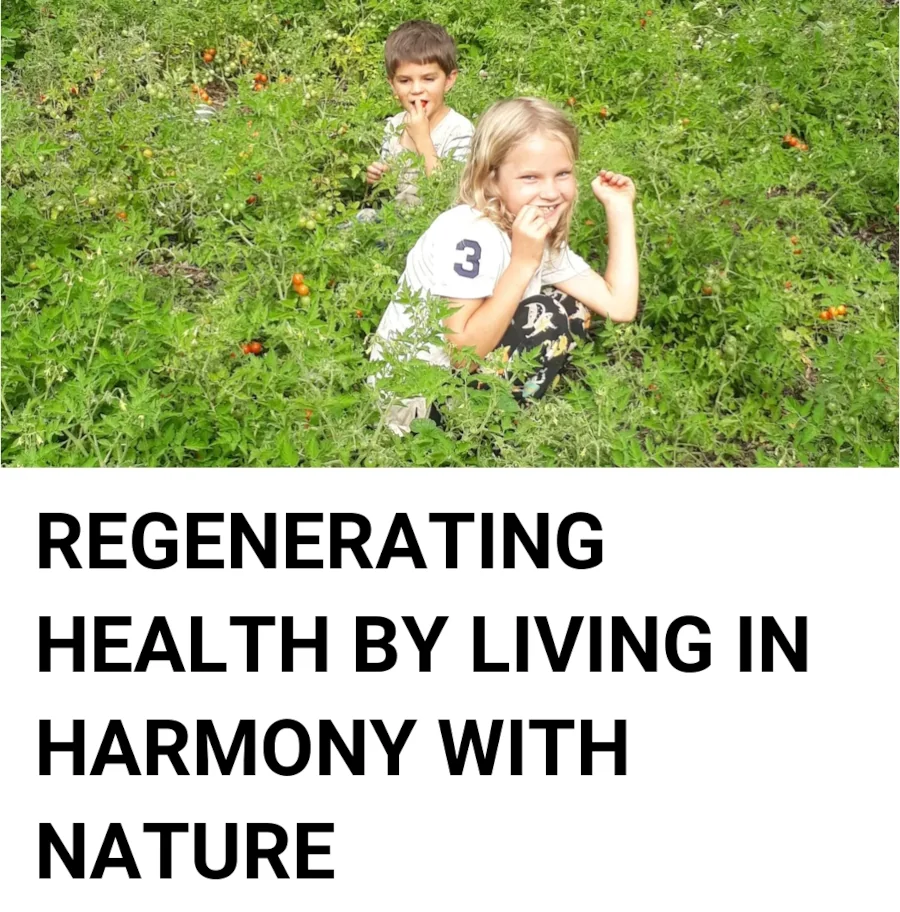
“Life is a precious gift we receive on the day we are born. Each of us has the power to take care of our bodies, in order to keep them in top shape, regardless of our chronological age. By honoring the life within us with wisdom, awareness, and love, we can treat ourselves to the ultimate luxury of living happily and in good health, throughout our journey on this wonderful planet.”